

Ryzen 5 3600 vs. R5 2600: GPU Scaling Benchmark Test
Last August later much need I locked myself away for a few days to benchmark... But to be clear, no ane requested I had to be locked away, but that's just what it took in order to get all 900 benchmark runs done. With the release of 3rd-gen Ryzen many gamers wanted a detailed GPU scaling benchmark. That'south what we set out to deliver, testing iv GPUs with 3 different CPUs at 2 resolutions, iii quality presets, and iv games.
The goal was to see how the near affordable new Ryzen (R5 3600) and so most expensive 3rd-gen processor (R9 3900X) compared to the Core i9-9900K, the globe'due south all-time gaming CPU. In short, the Ryzen 5 3600 proved to be the all-time value option for gamers, more ofttimes than not matching the Ryzen nine 3900X. Using an RTX 2080 Ti with medium quality settings at 1080p, the affordable Ryzen was only xiv% slower on average when compared to the 9900K.

Nevertheless with a more reasonable GPU such equally the $350 Radeon RX 5700 at 1440p with ultra quality settings, the Ryzen 5 processor was simply 4% slower than the 9900K, while averaging over 120 fps.
Since then nosotros've seen our fair share of new CPUs and other hardware that had to become reviewed and tested, merely we've been sitting for weeks on similar scaling results and data comparing the excellent Ryzen v 3600 against its predecessor, the Ryzen v 2600 which is to this day a great value CPU choice.
Gamers asking if they should spend ~$seventy more on the R5 3600, or simply get the 2600, this is the article for you. It was time to get these results out.

For testing, both AMD CPUs were paired with Thou.Skill DDR4-3200 CL14 memory and the Corsair H115i Pro libation. Auto overclocking features such every bit MCE or PBO were disabled and the retention was not tuned, just XMP loaded. In other words, nosotros're looking at out of the box operation with a quality all-in-one cooler and low latency memory. Let'due south get into the results.
Benchmarks
Starting with Assassin'southward Creed Odyssey at 1080p using medium quality settings, at the summit of the graph we have the RTX 2080 Ti and here we see the 3600 is up to 28% faster than the 2600.
That's a big performance jump and those with loftier refresh charge per unit monitors will certainly detect this improvement. Nevertheless, if you lot're using a $500 graphics card with these $200 (or less) CPUs, so the margins are far less extreme. Here the 3600 was just 13% faster when comparing the boilerplate frame charge per unit while the 1% low performance was virtually identical.

With more mainstream GPUs, like the $350 Radeon RX 5700, the 3600 is simply 8% faster. Finally for those using an RX 580 or a GPU of roughly equivalent performance, in that location'southward virtually no difference between the 2600 and 3600 under these test conditions.
This volition also of course exist true of anyone using a GPU that'south slower than the RX 580.

Now if nosotros alter the quality preset from medium to ultra high, things change quite a bit and this is a more advisable quality setting for those using an RTX 2080 Ti, specially at just 1080p. Here we run across virtually no difference in performance between the 2600 and 3600 using the 2080 Ti, in fact the 2600 was simply a few frames slower than the 9900K in this examination scenario.
It'south a like story with the RTX 2070 Super and RX 5700. At most the Ryzen R5 2600 was three fps slower than the 3600, delivering identical performance. Naturally we'll encounter the same result with the RX 580 and with slower GPUs besides.

Jumping to 1440p using medium quality settings changes the picture show from what nosotros saw at 1080p. Previously, the 3600 was up to 28% faster than the 2600, here it's merely 7% faster with the 2080 Ti.
Similar margins are seen when testing with the RTX 2070 Super and RX 5700, while we run into virtually no performance deviation with the RX 580.

The final ACO examination takes place at 1440p with the ultra high quality preset. Only as nosotros found at 1080p using this preset, in that location'south near no deviation in operation between the 2600 and 3600. Fifty-fifty with the 2080 Ti we're heavily GPU limited under these examination conditions.
Far Cry New Dawn
Nosotros've included this title deliberately as it represents the kind of performance you're likely to run across in older games. This is also a championship that caused performance problems for Ryzen processors, at to the lowest degree performance limiting bug.
Overall functioning was still quite adept and certainly smooth and very playable equally nosotros see here with the Ryzen 5 2600.

When using the normal or medium quality preset we meet that the R5 3600 is 15% faster at 1080p with the RTX 2080 Ti, 2070 Super and even the RX 5700.
Even with the RX 580 we encounter some operation improvement over the 2600 here.

Increasing the quality settings places boosted load on the CPU, too as the GPU, and every bit a result the margin between the 2600 and 3600 increases, now the tertiary-gen hexa-core processor is up to 29% faster with the 2080 Ti, and like margins are also seen with the 2070 Super and RX 5700.
Again, it's not until we driblet down to the RX 580 that the margins are neutralized.
The margins at 1440p with the medium preset are slightly increased. Here the 3600 was eighteen% faster than the 2600 with the RTX 2080 Ti, previously we were seeing a 15% margin.
The 2070 Super and RX 5700 results are like until we drop to the sub-$200 RX 580 that nosotros become GPU jump and all CPUs are limited to the aforementioned level of performance.
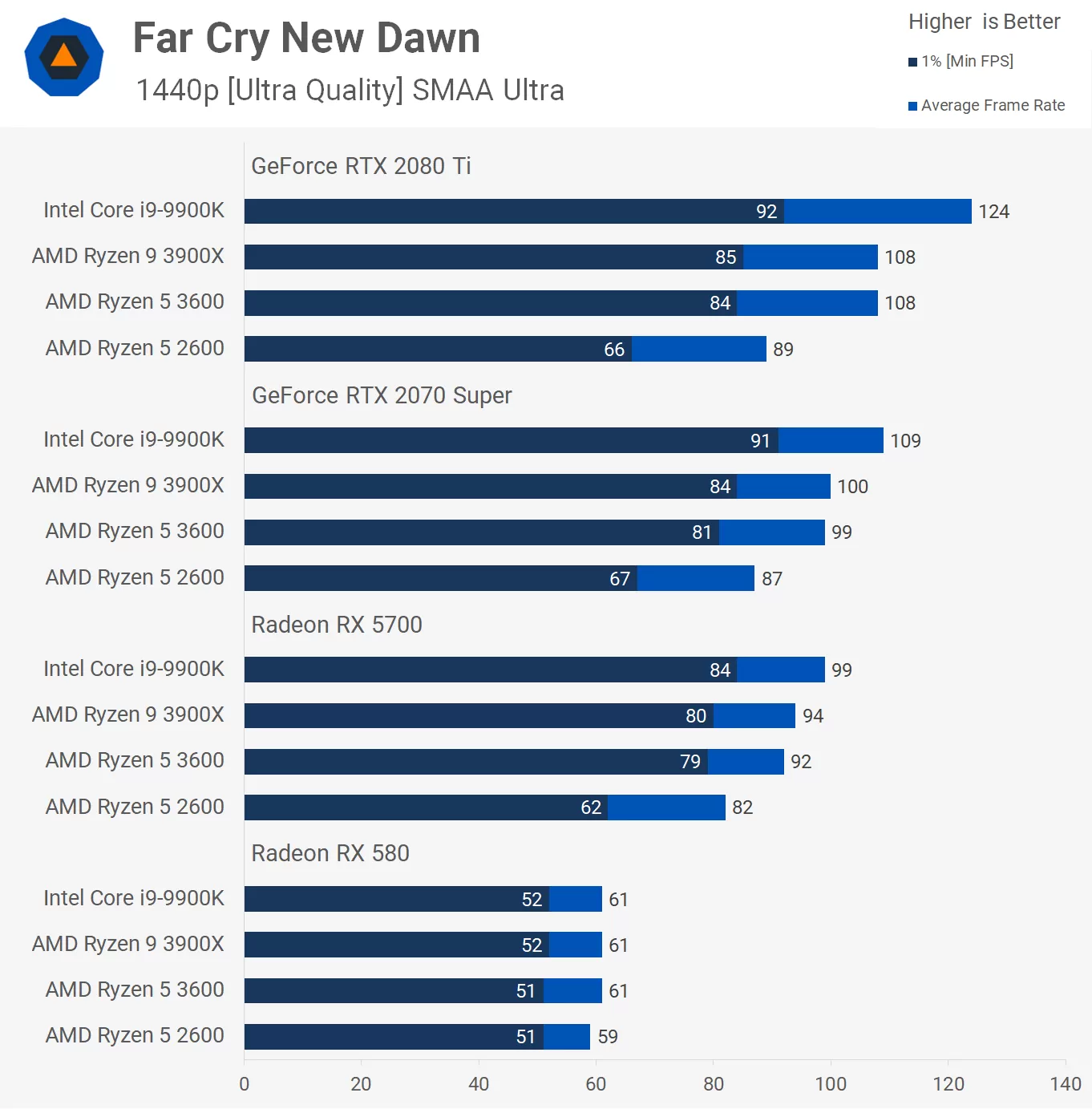
Increasing the resolution widens the margins. At 1440p with the ultra quality preset enabled the 3600 was up to 27% faster than the 2600. This is seen with the 2080 Ti, 2070 Super and RX 5700.
Tom Clancy's Rainbow Six Siege
When testing Rainbow Vi it should be noted that the "medium" quality setting is somewhat closer to 'high' as in that location's also 'very high' and 'ultra high' higher up it. So using the high quality preset at 1080p with a manually adapted render calibration of 100%, the Ryzen 3600 was up to 26% faster than the 2600 with the RTX 2080 Ti.

That margin is reduced to just 12% with the 2070 Super, though more than crucially, the 1% depression is almost identical across the 2600, 3600 and even the 3900X.
By the time we get downwards to the RX 5700 the 3600 is but ~viii% faster and even the 9900K is delivering a like level of performance.
Unsurprisingly the RX 580 sees all 4 CPUs evangelize the aforementioned level of performance.

Testing again at 1080p, but this time with the ultra quality settings, the R5 3600 is all the same a good bit faster when paired with the RTX 2080 Ti, delivering 24% more frames on average.
However as we saw with the medium quality preset, using the RTX 2070 S greatly reduces the margin to the point where they are virtually on par. The margin with the RX 5700 is basically non-real and is eliminated completely with the RX 580, which mind you is virtually pushing 100fps on boilerplate.

Previously at 1080p with the medium quality preset the 3600 was up to 26% faster than the 2600 when paired with the RTX 2080 Ti. This time using the same quality preset just at 1440p, nosotros find that the 3600 is only 6% faster when looking at average frame rates, while the 1% low performance is nearly identical.
Nosotros see the same performance with the RTX 2070 Super, though interestingly the 2600 does driblet off the footstep a petty when paired with the RX 5700.

The last Rainbow Six Siege examination takes place at 1440p with the ultra quality settings and hither the Ryzen 5 2600 however allowed for over 160 fps on average with the RTX 2080 Ti. In short, the 3600 and 2600 delivered identical functioning with all four tested graphics cards.
World War Z
Moving on to World War Z, first we have the medium quality results at 1080p. Using the RTX 2080 Ti the 3600 was 24% faster than the 2600 when comparing i% low performance. That said, the 2nd-gen part was still pushing over 100 fps at all times.

Dropping downward to the RTX 2070 Super reduced the margin to nineteen%, merely the 2600 was still pushing well over 100 fps. Surprisingly with the RX 5700 installed, the R5 3600 was up to 22% faster, then a decent functioning uplift.
Even with the RX 580 we see that the 3600 is up to ix% faster, something we've not seen in the other games tested, though none of the other titles saw frame rates exceed 150 fps.

Increasing the quality preset to ultra reduced the 3600's lead over the 2600 with the RTX 2080 Ti down from 24% to 18%, not a massive modify, but we are slightly more GPU limited here. Like margins were likewise seen when testing with the RTX 2070 Super and RX 5700.
The trend is articulate, it'southward not until nosotros drop to the budget RX 580 that the margins shut up, but even here the 2600 lags a fiddling behind the 3600.
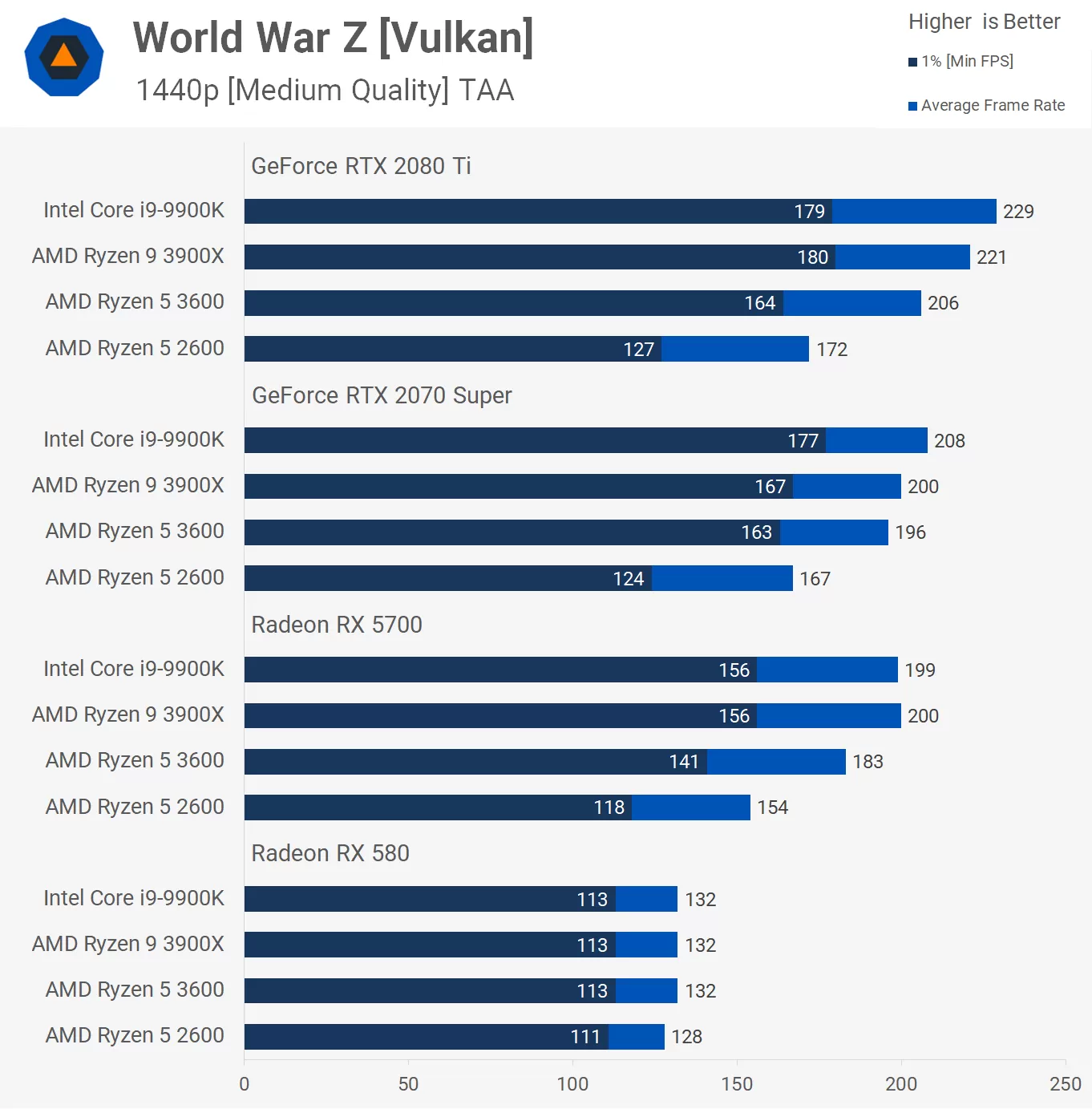
Once over again we meet that increasing the resolution actually increases CPU load and as a result the 3600 is up to 29% faster than the 2600 with the 2080 Ti at 1440p. The margin is reduced to 19% with the RX 5700 and and then just 3% with the RX 580.

Finally at 1440p/Ultra we meet that the 3600 is up to 23% faster than the 2600 when using the RTX 2080 Ti. That margin is reduced to 17% with the 2070 Super and then back up to 20% with the RX 5700. With the RX 580 we're looking at GPU limited frame rates and thus identical performance beyond all 4 tested CPUs.
Performance Summary
Every bit we mentioned in the feature preceeding this, we realize iv games is not a lot, merely it took near 300 benchmarks runs just to add together the Ryzen five 2600 into this comparison. The games used should also cover almost operation scenarios. That being the case, what does the average operation expect like?
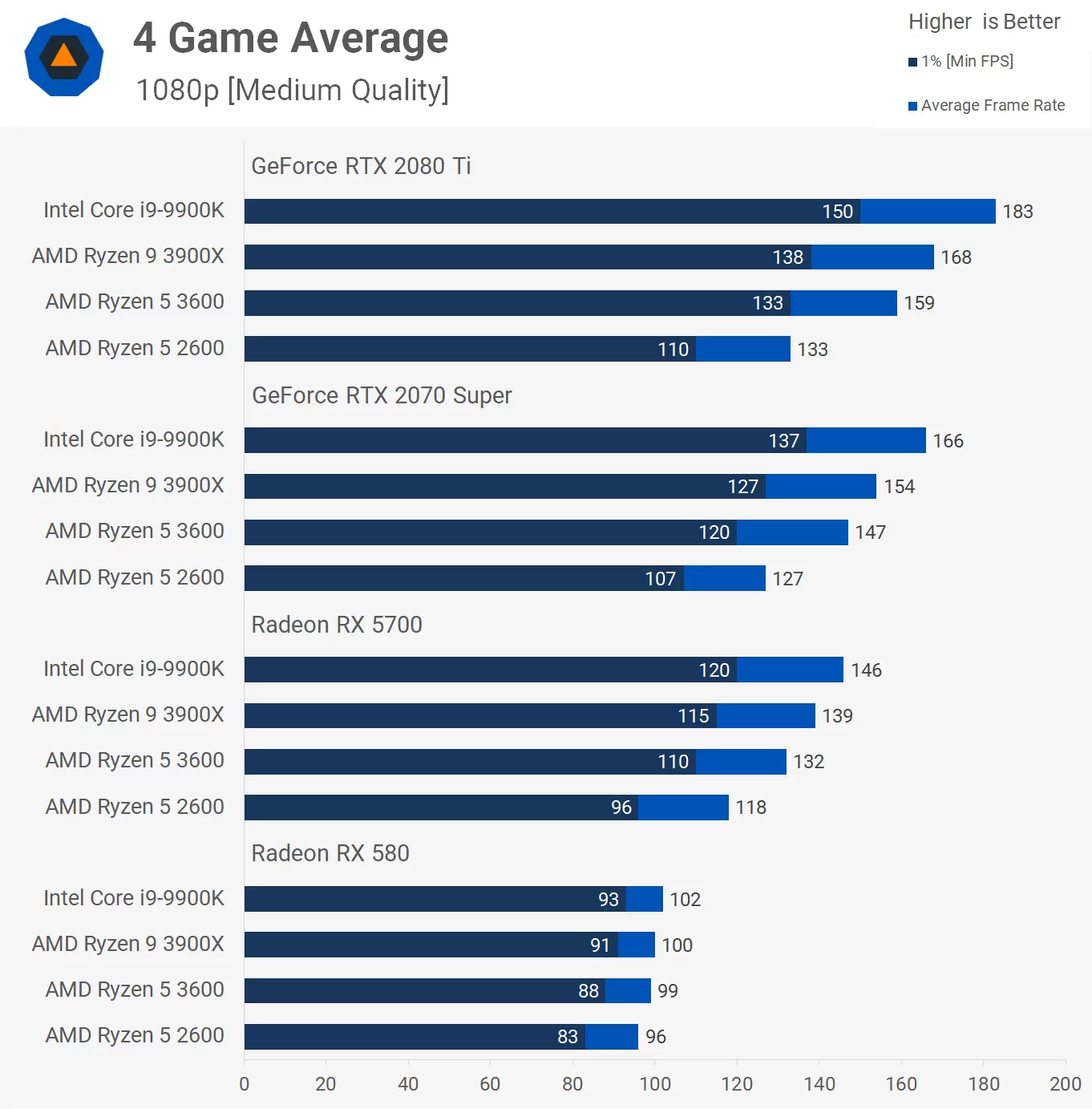
For those gaming at 1080p, using medium quality settings, with an RTX 2080 Ti... y'all're insane. Only seriously, in this worst-example scenario for the Ryzen 5 2600 we come across that the newer Ryzen 3600 was on boilerplate 21% faster.
For those using a $500 GPU under these conditions, you're still a fiddling nutty, but in whatsoever case the 3600 was xvi% faster on boilerplate with the 2070 Super.
Nosotros experience a more realistic pairing would be the Radeon RX 5700 and here the 3600 was just 12% faster on average, or 15% if we look at the 1% lows. Finally, if you're using an RX 580 or slower, the 3600 is really no faster than the 2600.

Now if nosotros increment the resolution to 1440p which I feel is a more than realistic choice with medium quality settings, even for RX 580 owners, nosotros see that the 3600 is merely 13% faster on boilerplate with the mighty RTX 2080 Ti, so not exactly a big gain over the 2600.
Similar margins are seen when testing with the 2070 Super and RX 5700, and so you're looking at less than 20% functioning improvement with the Ryzen 5 3600 over the 2600.

Using ultra quality settings, the 3600 was nineteen% faster on boilerplate with the 2080 Ti. That margin is reduced to only 13% with the 2070 Super and 16% with the RX 5700. And so for RX 580 owners you're looking at a 7% increase on average for the 1% depression functioning.

On a more enervating setting, gaming at 1440p, the Ryzen 3600 was on average 14% faster with the RTX 2080 Ti, 12% faster with the 2070 Super and fifteen% faster with the RX 5700. Nosotros see virtually no functioning difference with the RX 580.
What We Learned
In our original Ryzen five 3600 review which in addition to workstation and productivity tests included a 9-game benchmark covering 1080p and 1440p performance, we found when looking at just the 1080p numbers that on average the 3600 was 14% faster than the 2600. At the time the 2600 was retailing for $150 and the R5 3600 debuted at $200, pregnant the older 2nd-gen part came in at a 15% discount per frame.
Looking at the best example boilerplate performance for the Ryzen 3600 in today'south test, information technology was 21% faster with medium quality settings at 1080p. Worst case the 3600 was 12% faster at 1440p with ultra quality settings.

What has changed more than dramatically possibly is pricing. Today the Ryzen v 2600 can be purchased new for just $120, while the 3600 costs $195, making the newer office 63% more expensive. In other regions this margin volition vary, only in Australia for example, the pricing remains very similar.
If yous're later on maximum value and the best possible cost per frame, go the Ryzen v 2600 or perhaps the new 12nm Ryzen five 1600, which we programme to test soon. If you're afterwards maximum fps for $200 or less, then get the Ryzen v 3600, there are instances where it'due south nearly 30% faster.
Do note that looking at this strictly from a cost per frame perspective doesn't cistron in the cost of a motherboard, memory, or the rest of the organisation. An additional $75 expense on the CPU is a massive 63% increase, only if nosotros're talking almost a $1,000 organisation, it's less than 10%.

Granted, if yous applied the same mentality to all the components in your system you'd stop up well over budget... $70 more for the CPU, a tad more for the graphics card, more memory, improve motherboard, more storage, and earlier yous know it that $1,000 build is looking more similar $i,500. In any example, the point of this kind of test is to larn the actual differences in performance, then you only spend on a more expensive component that volition net you a noticeable increase in performance. Otherwise, save the $75 and put it towards an upgrade in a few years' fourth dimension, at which signal you should be able to buy a noticeable operation improvement.
Bottom line, the Ryzen five 3600 is clearly the faster processor and nosotros honey it for the solid performance it offers for gaming and productivity tasks. But if you're looking to get the about bang for your buck, the discounted 2nd-gen parts are the way to get.
Shopping Shortcuts:
- AMD Ryzen 5 3600 on Amazon
- AMD Ryzen v 2600 on Amazon
- AMD Ryzen 7 3700X on Amazon
- AMD Ryzen 3 3400G on Amazon
- Intel Cadre i5-9600K on Amazon
- Intel Cadre i5-9400F on Amazon
- AMD Radeon RX 5700 on Amazon
- GeForce RTX 2070 Super on Amazon
- GeForce RTX 2060 Super on Amazon

Source: https://www.techspot.com/review/1968-ryzen-3600-vs-2600-gaming-scaling/
Posted by: espinalusety1958.blogspot.com
0 Response to "Ryzen 5 3600 vs. R5 2600: GPU Scaling Benchmark Test"
Post a Comment